
 Get a Quote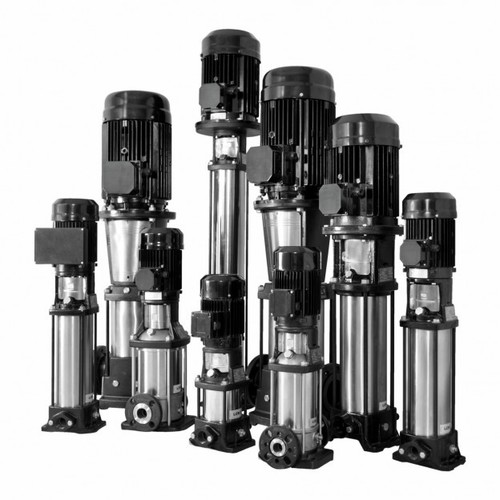
Vertical Multistage Pumps
Product Details:
- Theory Centrifugal Pump
- Flow Rate Up to 80 m/h
- Material Stainless Steel (AISI 304/316), Cast Iron End Covers
- Structure Multistage, Inline
- Suction Type Axial Flow
- Volute Type Single Volute
- Nozzle Location Top Centerline
- Click to view more
X
Vertical Multistage Pumps Price And Quantity
- 1 Piece
Vertical Multistage Pumps Product Specifications
- Single Volute
- Centrifugal Pump
- Stainless Steel (AISI 304/316), Cast Iron End Covers
- Electric
- DN 25 to DN 100 mm
- -15C to 120C
- Up to 80 m/h
- Top Centerline
- Axial Flow
- N/A (Electric Drive)
- Booster Systems, Water Treatment, Pressure Washing, Irrigation, Industrial Processes
- Up to 25 bar
- Vertical
- Multistage, Inline
- 2900 rpm
- Clockwise, Viewed from Motor End
- Flooded
- Enclosed Impeller
- Flexible Coupling
- Self Priming (Initial) or Manual
- Mechanical Seal
- 380-415V, 3 Phase, 50 Hz
- Base Mounted
- Below 75 dB(A)
- IP55
- Approx. 40 to 85 kg depending on model
- Heavy Duty, Deep Groove Ball Bearing
- Vertical Inline
- TEFC (Totally Enclosed Fan Cooled)
Vertical Multistage Pumps Trade Information
- as per oder Per Week
- as per oder Week
Product Description
Applications:
Water supply
Filtration and transfer at waterworks
Distribution from waterwork
Pressure boosting in high-rise buildings, hotels, etc.
Pressure boosting for industrial water supply
Industry Pressure boosting in
Process-water systems
Washing and cleaning systems
Vehicle washing tunnels
Fire-fighting systems
Liquid transfer in
Cooling and air-conditioning systems (refrigerants)
Boiler feed and condensate systems
Machine tools (cooling lubricants)Aquafarming Transfer of
Oils and alcohaols
Acids and alkalis
Glycol and coolantsWater treatment
Ultra-filtration systems
Reverse osmosis systems
Softening, ionizing, demineralizing systems
Distillation systems
Separators
Swimming bathsIrrigation
Field irrigation (flooding)
Sprinkler irrigation
Drip-feed irrigation
Features:
The LCR pumps are non-self-priming, vertical multistage centrifugal pumps.
The pump consists of a base and a pump head. The chamber stack and the outer sleeve are secured between the pump head and the base by means of tie bolts.
The base has suction and discharge connections on the same level (in-line).
All pumps are equipped with a maintenance-free mechanical shaft seal of the cartridge type as standard
LCR, LCRI and LCRN pumps are fitted with a totally enclosed, fan-cooled, 2-pole motor with principal dimensions in accordance with the EN standards.
Electrical tolerances according to EN 60034.
High Performance and Reliability
Designed with deep groove ball bearings and flexible couplings, these vertical multistage pumps offer trouble-free operation and reliable performance in demanding environments. The structure allows for smooth, quiet running below 75 dB(A), ensuring minimal disruption in industrial and commercial installations.
Versatile Applications
Suitable for a wide range of tasks, these pumps are ideal for booster systems, water purification plants, irrigation needs, pressure washing, and several industrial processes. Their robust build and high-pressure capability make them an excellent choice for both utility and process water handling.
Robust Construction
Made from high-grade stainless steel (AISI 304/316) and cast iron end covers, these pumps resist corrosion and withstand harsh operating conditions. The vertical inline configuration aids in saving floor space and simplifies piping arrangements.
FAQs of Vertical Multistage Pumps:
Q: How do vertical multistage pumps operate in booster systems?
A: These pumps utilize multiple staged impellers to incrementally increase water pressure, making them highly effective for booster systems needing consistent and elevated pressure across buildings or industrial processes.Q: What is the benefit of a mechanical seal in these pumps?
A: Mechanical seals minimize leakage and provide enhanced reliability, especially in high-pressure and temperature conditions, reducing maintenance intervals and ensuring continuous operation.Q: When should manual or self-priming be used during pump operation?
A: Initial priming can be performed manually if self-priming is unavailable, particularly during the first operation. After this, the pumps flooded suction and design generally maintain prime for subsequent use.Q: Where is the optimal installation location for these vertical inline pumps?
A: These pumps are best installed in vertical inline positions, with suction at the axial flow top centerline nozzle, which simplifies integration into existing pipework and conserves floor space in plant rooms.Q: What is the typical process for maintaining these multistage pumps?
A: Routine inspections of bearings and seals, checking for noise and vibration, and monitoring electrical connections are recommended to ensure longevity and optimal performance. Their heavy-duty construction allows for longer service intervals.Q: How does the flexible coupling contribute to pump usage?
A: Flexible couplings dampen vibration and compensate for slight misalignments between the pump and motor, thereby safeguarding internal components and enhancing the units overall durability.Q: What major benefits do users in India gain from these pumps?
A: Users benefit from high efficiency, robust materials adapted to local water quality, pressure handling up to 25 bar, and compatibility with standard industrial electrical supplies, making them viable for a vast range of applications.Tell us about your requirement

Price:
Quantity
Select Unit
- 50
- 100
- 200
- 250
- 500
- 1000+
Additional detail
Mobile number
Email

Other Products in 'Lubi' category

Contact Details

- 308, Bhaveshwar Arcade, Opposite Shreyas Cinema, L.B.S. Marg, Ghatkopar (West), Mumbai - 400086, Maharashtra, India
- Phone : 08045478396
DYNAMIC PRODUCTS
GST : 27AAHFD0720F1ZX
GST : 27AAHFD0720F1ZX

- Mr Manish Parekh (Partner)
- Mobile : 08045478396
- Mr. Ashit Parekh (Partner)
- Mobile : 08045478396
- Send Inquiry
 Send Inquiry
 Send Inquiry
 Send SMS
DYNAMIC PRODUCTS
All Rights Reserved.(Terms of Use)
Developed and Managed by Infocom Network Private Limited.
Developed and Managed by Infocom Network Private Limited.


